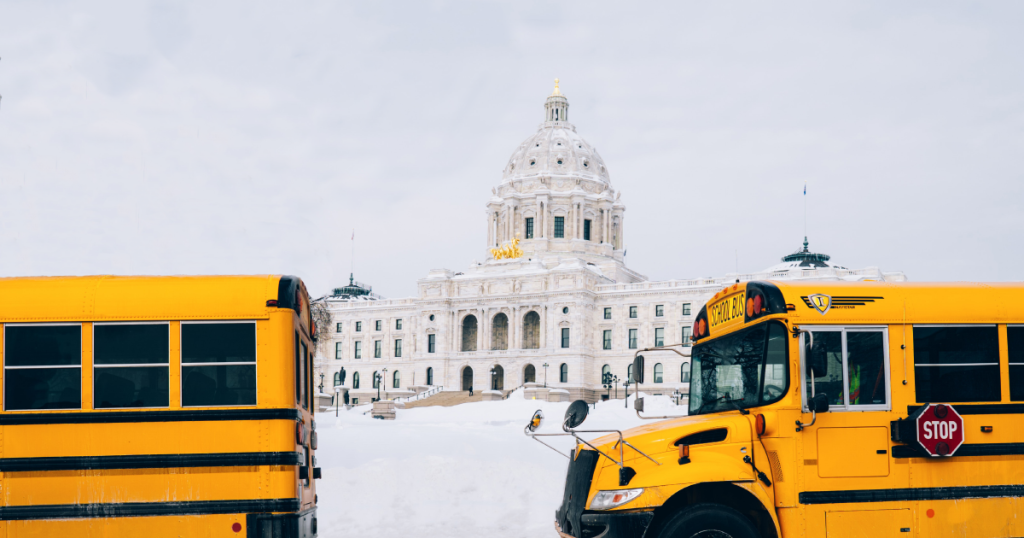
Much has been ballyhooed about the nationwide “blue tsunami” that swept Democrats into office during last week’s midterm elections. The DFL, Minnesota’s own flavor of the Democratic Party, was no exception.
Despite local predictions of DFL fatigue, the party won a decisive governing trifecta: one-party control of the House, Senate, and office of the governor. This will be the second DFL trifecta in four years, this time under very different circumstances.
With the last time the state elected a DFL trifecta in 2023 as our guide, what can we expect in 2027?
Today, we’re looking at the broader political environment. We’ll share more about what to expect from EE in advancing equitable, student-centered learning for all as we get closer to the legislative session.
Then: Bounty. Now: Austerity?
With the largest budget surplus in state history to work with—$17.6 billion—the 2023 DFL trifecta passed a bill for universal school meals and increased K-12 funding by more than 10 percent, or $2.2 billion. They made no secret: Democrats were checking off wishlist items, a long overdue “historic investment” in K-12 chief among them.
We expect a more meager surplus in 2027, if any. (It could be a few billion, somehow meager in today’s dollars.) We’ll get a new budget forecast in three weeks, but don’t expect ambitious leaps in K-12 investment next year. Instead, lawmakers will be squaring bills already due.
Special Education
Without a legislative remedy, special education cross subsidy aid will be subject to automatic reductions—cuts—beginning July 2027. The Blue Ribbon Commission on Special Education, tasked with finding $250 million in “cost savings” to avoid these effective cuts, urged lawmakers to repeal the automatic reduction.
In their report this fall, the Commission minced no words when warning of “the direct and harmful impacts these cuts would have on the state’s students with disabilities, their families, and the schools that serve them.”
Lawmakers seem likely to make the repeal. A show-vote to repeal sailed with unanimous support in the House last spring. How will lawmakers cover the cost? Less clear.
Compensatory Revenue
Schools rely on this funding targeted to academically underprepared students, historically calculated using free or reduced-price lunch counts. But universal school meals and fears about immigration enforcement wiped out the incentive for families to fill out the forms needed to generate compensatory dollars for their kids.
A Compensatory Revenue Task Force—also with a report out this fall—offered a slate of recommendations to stabilize and equitably distribute compensatory dollars. But make no mistake: The recommendations were never intended to save money. Lawmakers may need to find dollars or face another area of effective cuts.
Constitutional Amendment
Lost in the headlines was Minnesota’s most decisive election night victory: 73% support on the school funding ballot question. The thumbs-up from voters allows the state to draw more dollars from a sizable, permanent investment fund dedicated to schools without ever touching the principal balance.
Bottom line: The change could amount to $33 more per student, statewide, at no cost to taxpayers. A welcome windfall, but still not a solution to costlier education budget woes.
Then: Narrow margins. Now: Blowout.
The 2023 trifecta boasted only a one-vote majority in the Senate, a more comfortable six seats in the House. The political reality meant that Republicans and moderates in both parties held sway. A single DFL defection in the Senate forced bipartisanship.
Even so, much of the DFL wishlist went through on party lines. A few Republican senators voted for universal school meals, but the broader education funding package got by with only DFL support.
With majorities of about a dozen and 20 seats in the Senate and House respectively, Democrats don’t need to reach across the aisle. They don’t even need to shore up their entire caucus for winning majorities. But there’s one Democrat they will need.
Amy Klobuchar.
The X-ecutive Factor
One of the three legs of the 2023 trifecta was proclaimed progressive Tim Walz. The “teacher governor”, Walz was less hands-on legislatively as the state’s chief executive, but had strong feelings about education and touted the significant K-12 investments made on his watch.
Minnesotans have known Sen. Klobuchar a long time, but constituents have a different relationship with their governor. This is new territory for everyone. The bipartisan Senate deal-maker seems likely to be more hands-on legislatively, and Klobuchar warned supporters on election night that they might not like everything she does.
She also repeated a refrain from her campaign: “We will raise student achievement and lower time spent on screens.” There’s more to Klobuchar’s education agenda than that, if not a lot more, nestled inside her Minnesota workforce agenda. Our friend at EdAllies, Madie Spartz, wrote about this before the election.
Room to grow and be more explicitly student-centered? We’ll work to make it so.
On deck for the governor-elect: Deciding who will staff the Department of Education and proposing her own education budget bill. As a Senator, education simply was not Klobuchar’s focus. With K-12 spending nearly a third of state spending, it’s about to be.