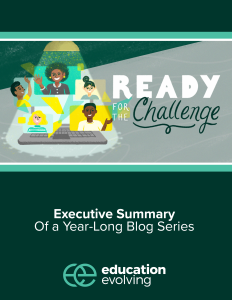
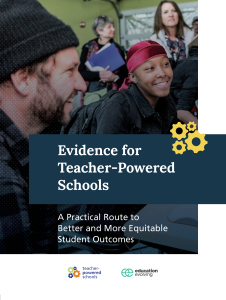
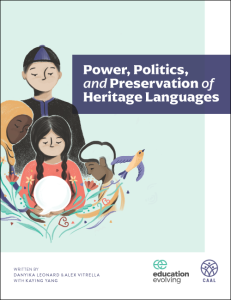
Publications Issue All Student-Centered Learning DesignsEducator Talent PathwaysOutcomes That MatterAutonomy and Shared Power A Beacon, a Barometer, and a Bridge Report • September 2024 How can statewide assessments and academic standards—both influential and required by federal law—best support education to be more equitable and student-centered? This paper provides nine concrete recommendations. Understanding Teacher Retention at Teacher-Powered Schools Report • August 2023 With teachers leaving the classroom at record-high rates, we asked: What is retention like at teacher-powered schools? Could teacher-powered be an answer to the question of how to keep talented teachers? Seeing Opportunity with the Minnesota Student Survey Report • March 2023 Student surveys can help paint a holistic picture of student experiences and inform student-centered school improvement. This report presents recommendations for Minnesota’s statewide student survey. Equity in Student-Centered Learning Design Guide • January 2022 A collaborative guide to realize equity across your school. Features tips, examples, and discussion questions for your team. Ready for the Challenge: Ideas and Evidence from Student-Centered Learning in a Pandemic Blog Series • January 2022 Executive summary of a year-long blog series collecting ideas and evidence from student-centered learning in the Covid-19 pandemic. Navigating Policy for Personalized, Competency-Based Education Guide • March 2021 A guide for educators who are implementing personalized, competency-based programs and want help navigating Minnesota’s laws, regulations, and reporting requirements as they do so. Evidence for Teacher-Powered Schools: A Practical Route to Better and More Equitable Student Outcomes Report • September 2020 This paper makes the case to grow the teacher-powered movement through a review of academic research and a deep dive on several teacher-powered schools. Power, Politics, and Preservation of Heritage Languages Report • June 2020 In this paper, we explore why heritage language matters, the state and federal policies that support heritage language instruction, the learning programs leading this work, and the challenges heritage languages programs face. Retaining Teachers: Fostering Conditions Where Talent Thrives Blog Series • February 2020 Teacher turnover isn’t good—for student, for schools, or for teachers themselves. We dove deep on this issue in a year-long blog series, exploring data, stories of those impacted, and creative solutions. Teacher-Powered Practices: How Teacher Teams Collaboratively Lead and Create Student-Centered Schools Report • October 2019 How innovative teachers are radically changing the ways schools are designed and run. Explores common leadership practices, structures, and processes teacher-powered teams design and use daily. Post navigation 1 2 3 4 … 17 Next → Stay In Touch Get updates, new publications, fresh analysis, and event invitations in your inbox. First Name Last Name Email Address State What do you want to receive? Monthly newsletter (once per month) Blog posts by email (about two per month) See past newsletters in the archive.